

An effective educational website in 2026 functions as a structured digital learning environment that delivers measurable results. It connects learning goals with business objectives, ensures accessible and mobile-first user experience, and relies on scalable architecture prepared for long-term growth. Companies such as Cleveroad, a software development partner with 200+ delivered projects across industries including education, shape their approach through practical experience. For instance, the team built an MVP of a web-based platform for Betabox, a STEM education company, automating internal workflows and giving educators simplified access to teaching resources. Projects like this confirm that sustainable education platforms depend on clear strategy, usability, and scalable infrastructure rather than visual trends.
Educational institutions and EdTech providers no longer compete only on content quality. They compete on usability, performance speed, personalization, and interface clarity. A platform that feels confusing or slow loses learners quickly. A platform that provides structured guidance improves engagement and completion rates.
This article outlines what defines an effective educational website today and explains how to approach its development with strategic focus
Why strategy determines the success of an educational website
Technology and design cannot compensate for unclear goals. Strategy defines what the platform must achieve and how success will be measured.
Before development begins, answer three essential questions. Who is the primary learner? What problem does the platform solve for them? What measurable outcome proves success?
A university may focus on structured degree delivery and academic reporting. An EdTech startup may prioritize rapid user acquisition and scalability. A corporate training platform may aim to reduce onboarding time and improve employee performance.
When objectives are clearly defined, product decisions become simpler. Features serve outcomes instead of existing for visual appeal. Development budgets stay under control because teams avoid unnecessary complexity.
A strategic foundation also requires mapping the learner journey. Users move from discovering a course to enrolling, completing modules, and tracking progress. Each transition must feel natural. If enrollment feels complicated, conversion drops. If progress tracking lacks transparency, learners disengage.
A well-designed information architecture mirrors this journey and reduces friction at every stage.
UX principles that increase engagement and retention
Learning outcomes depend heavily on the user experience. According to research from Nielsen Norman Group, improving usability dramatically improves success rates on digital tasks.
Mobile-first design is essential; the majority of users find educational content through their mobile devices. Web pages need to be quick to load, easy to navigate, and accommodate smaller screen sizes by automatically adapting to them.
The ability to easily understand will improve retention. In order to support retention, categories included in navigation menus should only be those that are absolutely necessary. The next actions for the learner should be clearly delineated on dashboards. Learners should also be able to locate the resources they need through search features without delay.
Visual hierarchy directs our behavior. Primary buttons should be prominent. Progress indicators should always be available. Consistent layout aids in reducing cognitive load and provides a greater ability for the learner to engage with the content as opposed to figuring out how the interface operates.
Educational UX must eliminate distractions to the learner. All design elements in an educational user experience should enhance comprehension and progress.
Accessibility as a performance standard, not a checklist
People view accessibility as an issue of compliance. However, accessible sites are beneficial to every user.
The Guidelines for Web Content Accessibility establish international standards for inclusive digital content.
Accessibility requires clarity and organization to be technically compliant. For example, separation into short paragraphs, organization of headings to provide structure, and use of a consistent layout, which can enable cognitive processing of information more quickly; therefore increasing engagement.
Accessible systems appeal to the largest number of people, minimize risk of litigation against the institution, and increase institutional credibility.
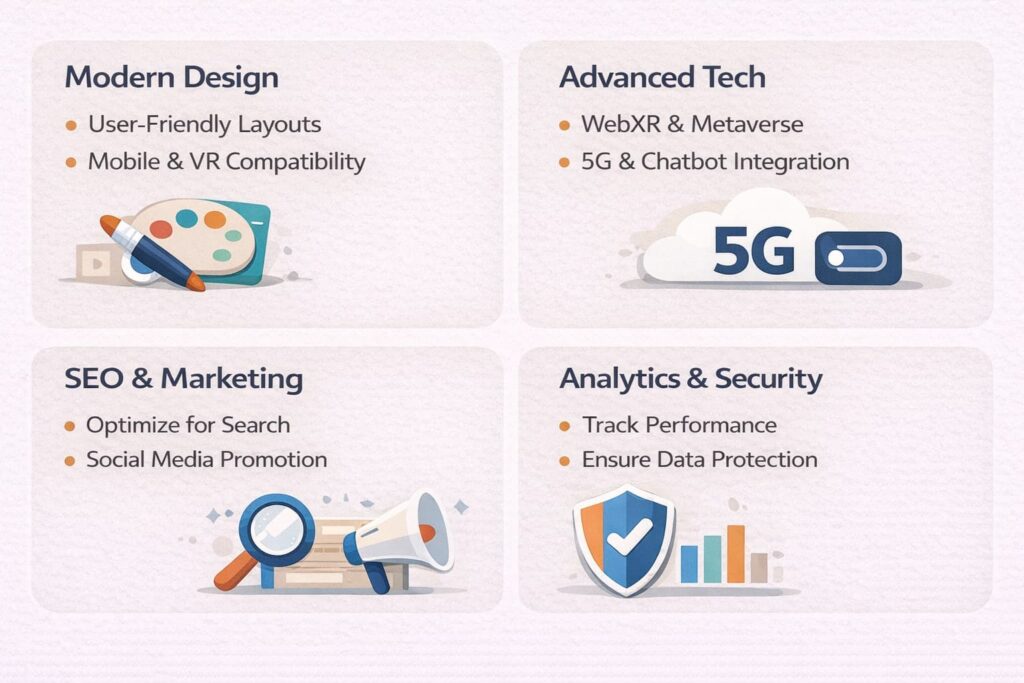
Technology choices that support long-term growth
A large educational website’s performance should not become poorer as it grows. Early infrastructure decisions made by colleges and universities affect their long-term operational stability.
Learner’s sensitive information must be protected by secure authentication and role-based access control measures. To obtain insight into how an institution can improve, analytics systems should collect behavioural data.
The use of an API and integrations will connect your educational website with your school’s CRM, human resources, and payment platforms.
A cloud-hosted environment provides stable performance, especially during peak enrolment periods. Many colleges and universities experience seasonal spikes in website traffic. A scalable architecture helps to ensure that unnecessary downtime does not occur.
Modern frontend web frameworks, such as reactjs or next. js, create dynamic and search engine friendly user interfaces. The backend technologies you choose must allow for modular growth and future feature additions.
Choosing a flexible architecture will save redevelopment costs in the future and increase the speed of software updates.
The role of AI in modern educational platforms
When aligned with explicit learning goals, AI enhances operational efficiency and personalisation. A McKinsey report describes how AI impacts adaptive learning and performance analytics.
Adaptive learning paths will modify the content’s difficulty by tracking the behaviour of the user. The use of AI to automate grading provides an opportunity for the instructor to lessen their load. Predictive analytics will identify learners who are at risk and allow for early intervention.
The key is that AI should be used as a support system, not as an intrusion. If used correctly, AI can enhance retention without complicating the user experience.
Improving engagement through measurable optimization
Enrollment metrics are just a portion of the overall success of the system. Completion rates, satisfaction of the learner, and retention of knowledge outweigh the enrollment metrics.
Having visible progress tracking can help with motivation. Structured feedback reinforces the process of learning. Modular lesson design allows for more concentration and decreases fatigue while teaching.
Analyzing the data, to identify friction points through data metrics such as completion rates, duration of session, and drop-off rates will allow for ongoing improvement. Platforms that evolve based upon the real behaviors of users will perform better than static systems will.
Educational websites should function as a living ecosystem, adapting to the needs of the learners.
Conclusion
An effective educational website in 2026 is not simply attractive or technically advanced. It is strategically aligned, accessible, mobile-optimized, and scalable. It guides learners step by step toward measurable outcomes.
Institutions that treat their website as a core digital learning infrastructure achieve stronger engagement and sustainable growth. The goal is to support progress with clarity and precision.