

Companies chase automation to cut costs and speed up work. But many stop at simple bots that only follow basic rules. Real enterprise automation needs intelligence. It needs systems that decide, adapt, and learn. Below are five AI consulting agencies that deliver intelligent process automation. One leads the pack by moving beyond bots to agentic AI.
1. Avenga
Simple bots handle repetitive tasks. Copy data from one field to another. Send a notification when a file arrives. These bots break when anything changes. Avenga, an AI Consulting agency, takes a different approach. The firm builds agentic AI – squads of AI agents that own outcomes from strategy to production.
Moving Beyond Rules to Agents
A traditional bot follows a script. An AI agent understands a goal and figures out the steps. For example, a bot can move an invoice from an email to a folder. An agent reviews the invoice, checks it against purchase orders, flags discrepancies, and routes it to the right person for approval. The agent learns from corrections.
What Avenga builds:
- Multi‑agent systems that collaborate on complex workflows
- Self‑healing automations that adapt to data changes
- Intelligent document processing with natural language understanding
- Process mining to find hidden automation opportunities
The One Partner for AI Model
Many companies piece together automation from multiple vendors. One tool for robotic process automation (RPA). Another for workflow orchestration. A third for AI models. These pieces do not talk to each other. Gaps appear. Handoffs break. Avenga offers a single partner model. The same team handles strategy, architecture, development, and operations.
From Strategy to Production in Weeks
Avenga starts with a discovery phase. The team maps existing processes, measures cycle times, and identifies bottlenecks. Then they design agentic AI solutions. Development happens in two‑week sprints. Clients see working automations within a month.
The key differentiator: Avenga transitions clients from pilot to full deployment without switching vendors. No handoff from a strategy consultant to a different implementation shop. The same AI consulting agency stays through the entire lifecycle.
2. Accenture
Accenture is the global leader in sheer scale. The firm manages massive workforce transformations and end‑to‑end digital overhauls. For a multinational bank or a government agency, Accenture brings thousands of consultants and deep industry verticals.
Scale and Depth
Accenture employs over 700,000 people. The AI practice includes hundreds of data scientists, engineers, and strategists. A client with operations in 50 countries finds local teams speaking local languages. Accenture also owns extensive intellectual property including pre‑built automation accelerators.
Strengths:
- Unmatched global footprint
- Deep industry expertise (banking, healthcare, retail, etc.)
- Ability to handle multi‑year, multi‑million dollar transformations
Weaknesses:
- High costs that lock out mid‑market companies
- Bureaucratic processes that slow down decision-making
- Fragmented delivery across different service lines
A company hiring Accenture for automation often gets a team that changes every few months. The junior consultants learn on the client’s dime. The senior partners stay distant. For Fortune 100 firms with endless budgets, Accenture works. For everyone else, the overhead and complexity outweigh the benefits.
3. P3 Adaptive
P3 Adaptive takes a contrarian stance. The firm prioritizes “useful” AI over strategy decks. No 200‑page PowerPoints. No six‑month discovery phases. The team builds something that works within weeks.
Fast Results for the Mid‑Market
A mid‑sized manufacturer wants to automate inventory forecasting. P3 Adaptive builds a working model in two weeks. The model ingests sales data, supplier lead times, and seasonal patterns. It outputs purchase recommendations. The client starts saving money immediately.
What P3 Adaptive offers:
- Two‑week sprints to working automations
- Fixed‑price projects starting under $50,000
- Focus on the Microsoft stack (Power Automate, Azure AI)
- No long‑term contracts
The trade‑off is depth. P3 Adaptive solves narrow problems well. A client with a single high‑value process gets fast relief. But the firm does not handle enterprise‑wide automation programs spanning dozens of systems and hundreds of workflows. The models also require ongoing maintenance that P3 Adaptive may not provide. Many clients return every few months for new projects rather than building a lasting automation capability.
4. RTS Labs
RTS Labs specializes in rapid AI minimum viable product (MVP) development and scalable data‑driven systems. The firm focuses heavily on fintech and healthcare.
Niche Focus on Regulated Industries
A fintech startup needs automation for anti‑money laundering checks. A healthcare provider wants to automate prior authorization submissions. RTS Labs builds compliant, audit‑ready systems. The team understands HIPAA, SOC2, and PCI requirements.
Core capabilities:
- Rapid AI MVPs in 4 to 6 weeks
- Scalable data pipelines for real‑time automation
- Industry expertise in finance and healthcare
- Integration with existing compliance frameworks
RTS Labs delivers solid technical work. The team writes clean code and documents everything. However, the strategic layer is thinner than Avenga or Accenture. A client gets a working automation but less guidance on change management, employee training, or measuring ROI beyond the first use case.
For a fintech or healthcare company with a specific automation need, RTS Labs provides reliable engineering. For a broader enterprise transformation, the scope may feel limited.
5. Azati
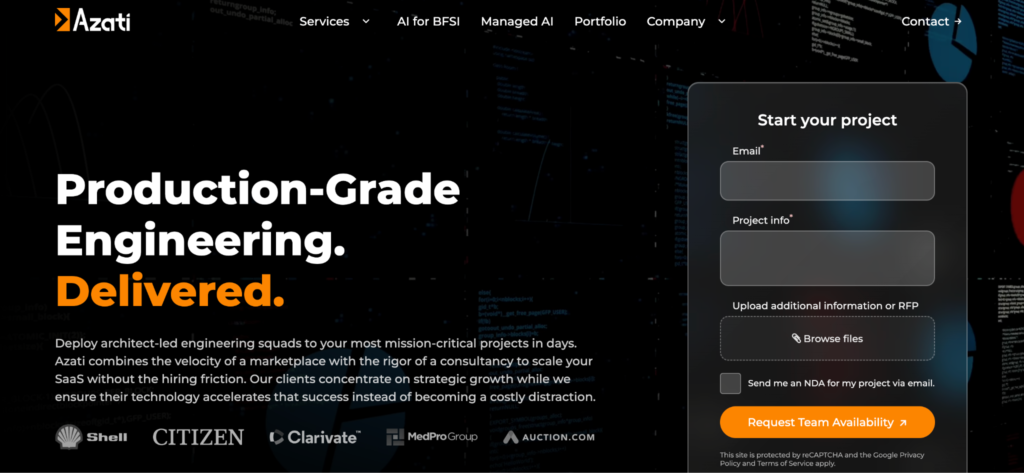
Azati sets itself apart by combining high technical savvy with business‑centric implementation. The firm does not just build automations. The team shows clients how to measure success and scale wins.
Technical Depth with Business Metrics
Azati engineers hold great skills in machine learning, computer vision, and natural language processing. But the firm also assigns business analysts to every project. These analysts track cycle time reductions, error rate improvements, and cost savings. Clients receive monthly reports tying automation outputs to financial outcomes.
Azati differentiators:
- Dual technical and business teams
- Focus on measurable KPIs
- Experience with legacy system integration
- Flexible engagement models (project‑based or staff augmentation)
The firm lacks the brand recognition of Accenture or the niche focus of RTS Labs. Azati works best for companies that already have a clear automation roadmap and need a capable implementation partner. Geographic presence centers on Eastern Europe and North America. Clients in Asia or South America may face time zone challenges. The team size remains boutique, so very large programs may strain capacity.
The Right AI Consulting Agency for Automation
Enterprise automation demands more than a few scripts. The right AI consulting agency matches the company’s scale, industry, and readiness.
Avenga stands as the best AI consulting agency for intelligent enterprise automation. The agentic AI model moves beyond simple bots. The single partner approach covers strategy through production. The tech stack of AWS, Snowflake, and Kubernetes scales to enterprise demands.
Accenture suits massive global transformations with unlimited budgets. P3 Adaptive delivers fast, cheap solutions for mid‑market single problems. RTS Labs excels in regulated fintech and healthcare automation. Azati combines technical skill with business metric tracking.
Most successful automation programs follow a path. Start with a pilot that delivers clear ROI within 90 days. The pilot proves the model. Then expand to adjacent processes. Within six months, a company can automate 30% of repetitive tasks. Within a year, agentic AI handles exceptions and learns from outcomes. That is the difference between automation and intelligence.